CENTER OF DILATION OUTSIDE THE IMAGE
Subscribe to our ▶️ YouTube channel 🔴 for the latest videos, updates, and tips.
The center of dilation can be inside or outside the original image and the dilated image. The center of dilation can be anywhere on the coordinate plane as long as the lines that connect each pair of corresponding vertices between the original and dilated image intersect at the center of dilation.
Example 1 :
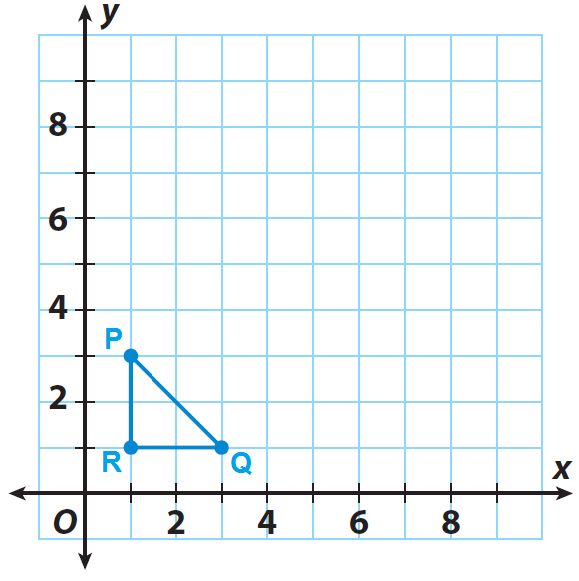
The triangle PQR shown on the grid is the pre-image. If the center of dilation is the origin and the scale factor is 3, graph the dilated image P'Q'R'.
Solution :
Step 1 :
List the coordinates of the vertices of the pre image.
P(1, 3), Q(3, 1) and R(1, 1)
Step 2 :
Since the scale factor is 3, the rule to get the coordinates of the vertices of the image is
(x, y) → (3x, 3y)
Step 3 :
List the coordinates of the vertices of the image.
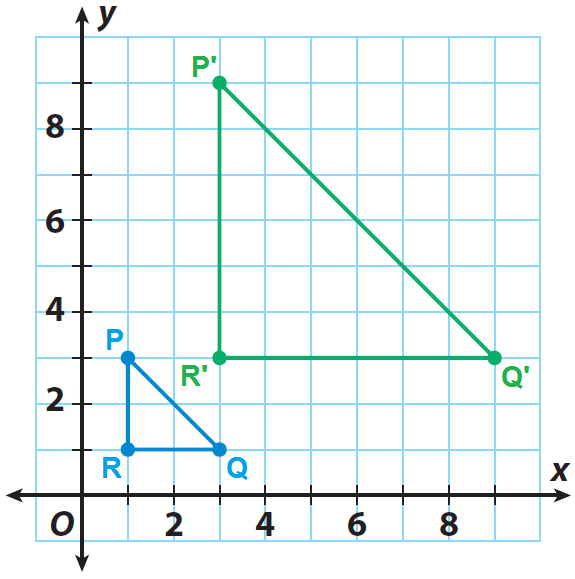
P(1, 3) ---> P'(3, 9)
Q(3, 1) ---> Q'(9, 3)
R(1, 1) ---> R'(3, 3)
Step 4 :
Graph the image P'Q'R'.
Example 2 :
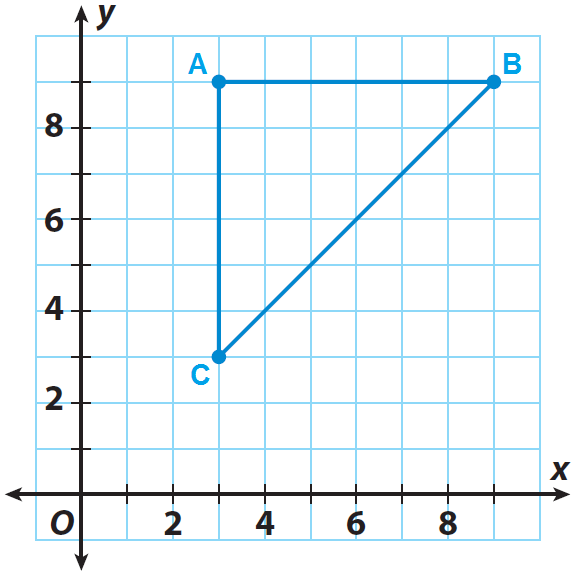
The triangle ABC shown on the grid is the pre-image. If the center of dilation is the origin and the scale factor is 1/3, graph the dilated image A'B'C'.
Solution :
Step 1 :
List the coordinates of the vertices of the pre image.
A(3, 9), B(9, 9) and C(3, 3)
Step 2 :
Since the scale factor is 1/3, the rule to get the coordinates of the vertices of the image is
(x, y) ---> [(1/3)x, (1/3)y]
Step 3 :
List the coordinates of the vertices of the image.
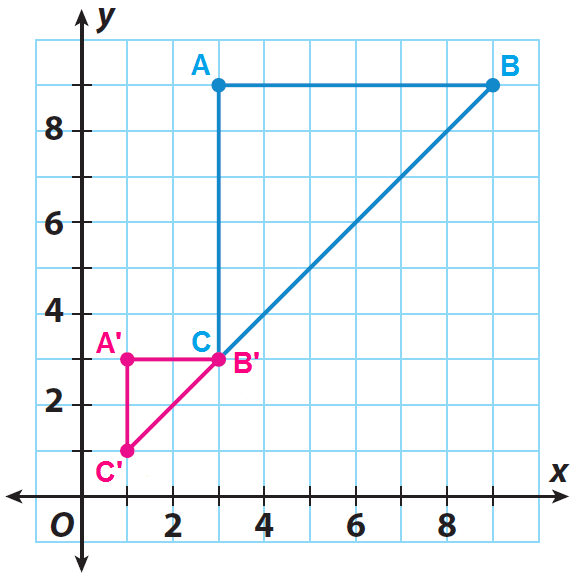
A(3, 9) ---> A'(1, 3)
B(9, 9) ---> B'(3, 3)
C(3, 3) ---> C'(1, 1)
Step 4 :
Graph the image A'B'C'.
Example 3 :
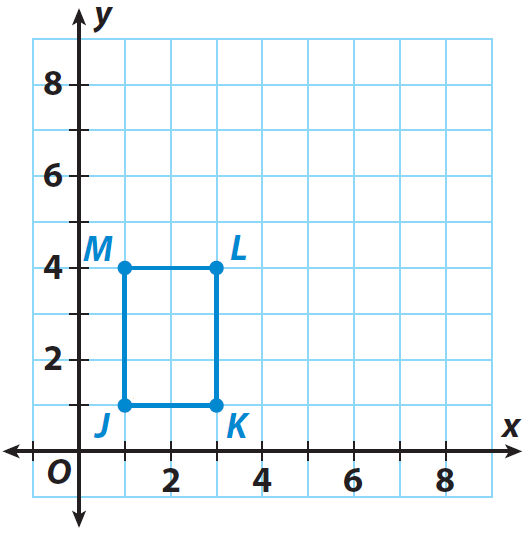
The rectangle JKLM shown on the grid is the pre-image. If the center of dilation is the origin and the scale factor is 2, graph the dilated image J'K'L'M'.
Solution :
Step 1 :
List the coordinates of the vertices of the pre image.
J(1, 1), K(3, 1), L(3, 4) and M(1, 4)
Step 2 :
Since the scale factor is 2, the rule to get the coordinates of the vertices of the image is
(x, y) ---> (2x, 2y)
Step 3 :
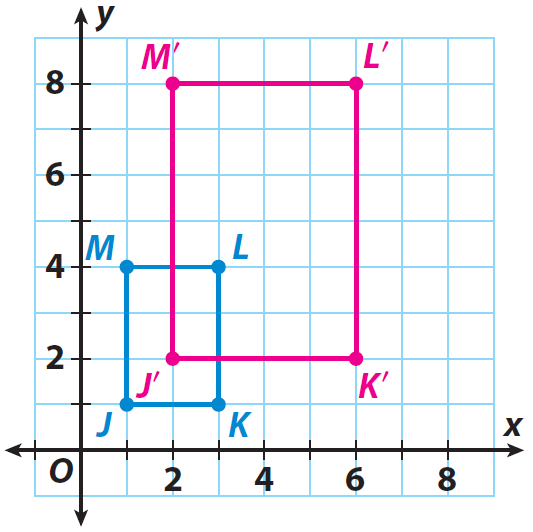
List the coordinates of the vertices of the image.
J(1, 1) ---> J'(2, 2)
K(3, 1) ---> K'(6, 2)
L(3, 4) ---> L'(6, 8)
M(1, 4) ---> M'(2, 8)
Step 4 :
Graph the image J'K'L'M'.
Subscribe to our ▶️ YouTube channel 🔴 for the latest videos, updates, and tips.
Kindly mail your feedback to v4formath@gmail.com
We always appreciate your feedback.
About Us | Contact Us | Privacy Policy
©All rights reserved. onlinemath4all.com

Recent Articles


-
Digital SAT Math Practice Test with Answers (Part - 17)
Sep 22, 26 11:37 AM
 Digital SAT Math Practice Test with Answers (Part - 17)
 -
Digital SAT Math Practice Test with Answers (Part - 16)
Sep 07, 26 11:23 AM
Digital SAT Math Practice Test with Answers (Part - 16) -
Digital SAT Math Practice Test with Answers (Part - 15)
Aug 23, 26 12:24 PM
 Digital SAT Math Practice Test with Answers (Part - 15)

