HOW TO FIND AREA OF TRIANGLE USING COORDINATES
Subscribe to our ▶️ YouTube channel 🔴 for the latest videos, updates, and tips.
Find the area of the triangle formed by the points.
Problem 1 :
(0, 0), (3, 0) and (0, 2)
Solution :
Let A(0, 0) , B(3, 0) and C(0, 2) be the vertices of the triangle taken in order.
x1 = 0 x2 = 3 x3 = 0
y1 = 0 y2 = 0 y3 = 2

Area of the triangle triangle ABC :
= (1/2)[(0 + 6 + 0) – (0 + 0 + 0)]
= (1/2)[6 - 0]
= (1/2)[6]
= 3 square units
Problem 2 :
(5, 2) (3, -5) and (-5, -1)
Solution :
Let A (-5, -1), B (3, -5) and C (5, 2) be the vertices of the triangle taken in order.
x1 = -5 x2 = 3 x3 = 5
y1 = -1 y2 = -5 y3 = 2

Area of the triangle ABC :
= (1/2)[(25 + 6 - 5) – (-3 - 25 - 10)]
= (1/2)[(31 - 5) –(-38)]
= (1/2)[26 +38]
= (1/2)[64]
= 32 square units
Problem 3 :
(-4, -5), (4, 5) and (-1, -6)
Solution :
Let A(-4, -5) , B(-1, -6) and C(4, 5) are the vertices of the triangle taken in order.
x1 = -4 x2 = -1 x3 = 4
y1 = -5 y2 = -6 y3 = 5

Area of the triangle ABC :
= (1/2)[(24 - 5 - 20) – (5 - 24 - 20)]
= (1/2)[(24 - 25) –(5 - 44)]
= (1/2)[(-1) – (-39)]
= (1/2)[-1 + 39]
= (1/2)[38]
= 19 square units
Problem 4 :
Given the triangle below with vertices 𝐴(−2, 3), 𝐵(4, 4), and 𝐶(−1, −2). Calculate its area.
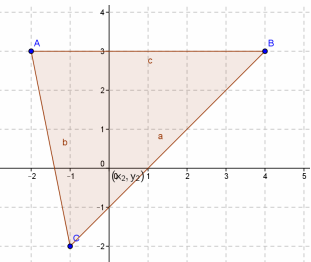
By observing the figure above, we can find the vertical distance between from C to AB.
Height = 5 units.
Distance between AB = √(y2 - y1)2 + (x2 - x1)2
𝐴(−2, 3), 𝐵(4, 4),
= √(4 - 3)2 + (4 - (-2))2
= √12 + (4 + 2)2
Base = √37
Area of triangle = (1/2) x √37 x 5
= 5/2√37 square cm.
Problem 5 :
Draw Triangle ∆𝑉𝐸𝑋 that has vertices 𝑉(−5, 2), 𝐸(−11, −1) 𝑎𝑛𝑑 𝑋(−3, −1).
a. Find the perimeter of ∆𝑉𝐸X
b. Find the area of ∆𝑉𝐸X
Solution :
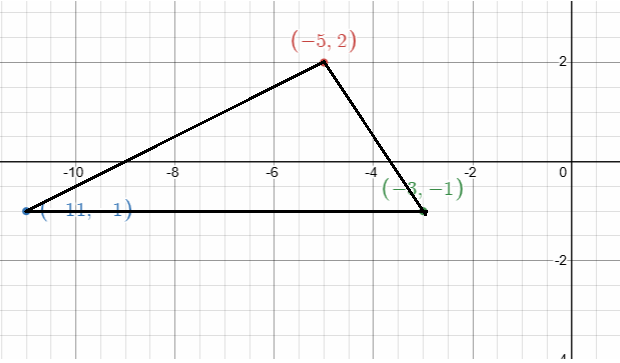
a) Finding the perimeter :
Distance between two points = √(y2 - y1)2 + (x2 - x1)2
𝑉(−5, 2), 𝐸(−11, −1)
Length of VE = √(-1 - 2)2 + (-11 + 5)2
= √(-3)2 + (-6)2
= √9 + 36
= √45
= 3√5
𝐸(−11, −1) 𝑋(−3, −1).
Length of EX = √(-1 + 1)2 + (-3 + 11)2
= √02 + 82
= √64
= 8
𝐸(−11, −1) 𝑋(−3, −1).
𝑉(−5, 2) and 𝑋(−3, −1).
Length of EX = √(-1 - 2)2 + (-3 + 5)2
= √(-3)2 + 22
= √9+4
= √13
perimeter of triangle VEX = VE + EX + XV
= (3√5 + 8 + √13) units
b) Finding the area of triangle VEX :
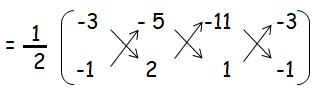
= 1/2{(-6 - 5 + 11) - (5 - 22 - 3)}
= (1/2) {(0 - (-20))
= 1/2(20)
= 10 square units.
Problem 6 :
Find the area of the triangle given below.
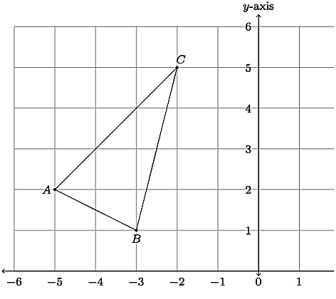
Solution :
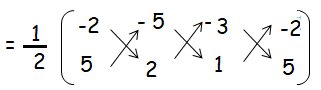
= 1/2 {(-4 - 5 - 15) - (-25 - 6 - 2)}
= (1/2) {(-24 - (-33))}
= (1/2) {(-24 + 33)}
= (1/2) {9}
= 4.5 square units.
So, the required area of the triangle above is 4.5 square units.
Problem 7 :
Find the area of the triangle given below.
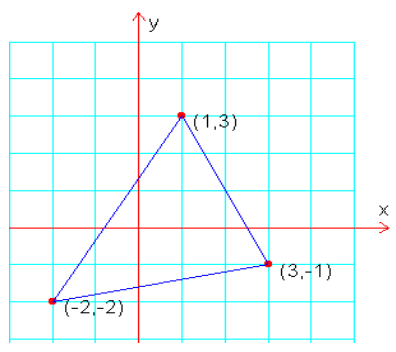
Let A (1, 3), B(-2, -2) and C(3, -1).
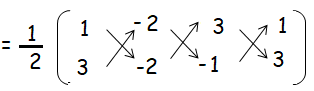
= (1/2) {(-2 + 2 + 9) - (-6 - 6 - 1)}
= (1/2) {9 - (-13)}
= (1/2)(9 + 13)
= 1/2 (22)
= 11 square units.
So, the required area of the triangle is 11 square units.
Problem 8 :
If the area of the triangle formed by the vertices A(-1 2), B (k ,-2) and C(7, 4) (taken in order) is 22 sq. units, find the value of k.
Solution :
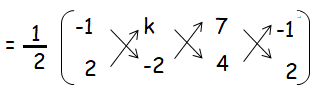
Area of the triangle = 22 square units.
(1/2){(4 + 4k + 14) - (2k - 14 - 4)} = 22
(18 + 4k) - (2k - 18) = 22(2)
18 + 4k - 2k + 18 = 44
36 + 2k = 44
2k = 44 - 36
2k = 8
k = 8/2
k = 4
So, the value of k is 4.
Find the area of the shaded region
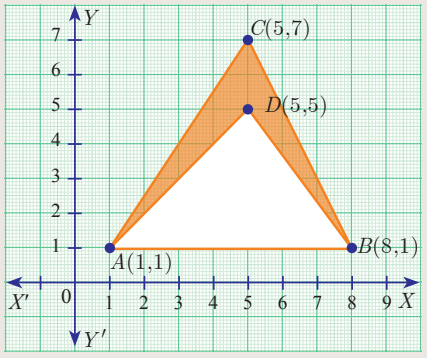
A(1, 1) B(8, 1) and C(5, 7)
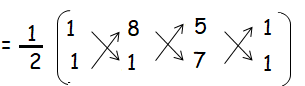
Area of triangle ABC = (1/2) {(1 + 56 + 5) - (8 + 5 + 7)}
= (1/2){62 - 20}
= (1/2) (42)
= 42/2
Area of triangle ABC = 21 square units.
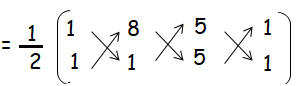
Area of triangle ABD = (1/2) {(1 + 40 + 5) - (8 + 5 + 5)}
= (1/2){46 - 18}
= (1/2) (28)
= 28/2
Area of triangle ABD = 14 square units.
Area of the shaded region = Area of triangle ABC - Area of triangle ABD
= 21 - 14
= 7 square units.
So, the area of the shaded region is 7 square units.
Subscribe to our ▶️ YouTube channel 🔴 for the latest videos, updates, and tips.
Kindly mail your feedback to v4formath@gmail.com
We always appreciate your feedback.
About Us | Contact Us | Privacy Policy
©All rights reserved. onlinemath4all.com

Recent Articles


-
Digital SAT Math Practice Test with Answers (Part - 18)
Oct 10, 26 06:38 PM
Digital SAT Math Practice Test with Answers (Part - 18) -
AP Calculus BC Problems with Solutions
Sep 30, 26 01:08 PM
 AP Calculus BC Problems with Solutions
 -
Digital SAT Math Practice Test with Answers (Part - 17)
Sep 30, 26 01:00 PM
 Digital SAT Math Practice Test with Answers (Part - 17)

