HOW TO FIND THE NEXT THREE TERMS IN ARITHMETIC SEQUENCE
Subscribe to our ▶️ YouTube channel 🔴 for the latest videos, updates, and tips.
The following steps will be useful to find the next three terms in an arithmetic sequence.
Step 1 :
Using the given terms, find the common difference.
Formula to find common difference 'd' :
d = a2 - a1
Step 2 :
Add the value of 'd' to each term to generate the next term.
For example, if a1, a2, a3 are in arithmetic sequence, you can add 'd' to a3 to generate a4 and so on.
That is,
a4 + d = a5
a5 + d = a6
a6 + d = a7
Example 1 :
Find the next three terms of each arithmetic sequence.
4, 7, 10, 13, …
Solution :
Common difference :
d = a2 - a1
= 7 - 4
= 3
In order to get 5th term, we have to add the common difference 3 with the 4th term.
|
a5 = a4 + d = 13 + 3 a5 = 16 |
a6 = a5 + d = 16 + 3 a6 = 19 |
a7 = a6 + d = 19 + 3 a7 = 21 |
Hence the next three terms of the above sequence are 16, 19 and 21.
Example 2 :
Find the next three terms of each arithmetic sequence.
18, 24, 30, 36, …
Solution :
Common difference :
d = a2 - a1
= 24 - 18
= 6
In order to get 5th term, we have to add the common difference 3 with the 4th term.
|
a5 = a4 + d = 36 + 6 a5 = 42 |
a6 = a5 + d = 42 + 6 a6 = 48 |
a7 = a6 + d = 48 + 6 a7 = 54 |
Hence the next three terms of the above sequence are 42, 48 and 54.
Example 3 :
Find the next three terms of each arithmetic sequence.
-66, -70, -74, -78, …
Solution :
Common difference :
d = a2 - a1
= -70 - (-66)
= -70 + 66
= -4
In order to get 5th term, we have to add the common difference 3 with the 4th term.
|
a5 = a4 + d = -78 + (-4) = -78 - 4 a5 = -82 |
a6 = a5 + d = -82 + (-4) = -82 - 4 a6 = -86 |
a7 = a6 + d = -86 + (-4) = -86 -4 a7 = -90 |
Hence the next three terms of the above sequence are -82, -86, and -90.
Example 4 :
Find the next three terms of each arithmetic sequence.
-31, -22, -13, -4, …
Solution :
Common difference :
d = a2 - a1
= -22 - (-31)
= -22 + 31
= 9
In order to get 5th term, we have to add the common difference 3 with the 4th term.
|
a5 = a4 + d = -4 + 9 a5 = 5 |
a6 = a5 + d = 5 + 9 a6 = 14 |
a7 = a6 + d = 14 + 9 a7 = 23 |
Hence the next three terms of the above sequence are 5, 14 and 23.
Example 5 :
Online bidding for a purse increases by $5 for each bid after the $60 initial bid.
|
Bid number 1 2 3 4 |
Bid amount $60 $65 $70 $75 |
a. Write a function that represents the arithmetic sequence.
b. Graph the function.
c. The winning bid is $105. How many bids were there?
Solution :
a.
fn = a + (n - 1) d
fn = 60 + (n - 1) (65 - 60)
= 60 + (n - 1) (5)
= 60 + 5n - 5
= 55 + 5n
So, the required function which represents the sequence is 55 + 5n.
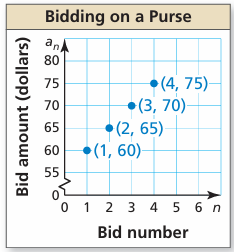
c. Amount of winning bid = 105
105 = 55 + 5n
Solving for n, we get
5n = 105 - 55
5n = 50
n = 50/5
n = 10
So, there were 10 bids.
Example 6 :
A carnival charges $2 for each game after you pay a $5 entry fee.
|
Games 1 2 3 4 |
Total cost $7 $9 $11 $13 |
a. Write a function that represents the arithmetic sequence.
b. Graph the function.
c. How many games can you play when you take $29 to the carnival?
Solution :
a) fn = a + (n - 1) d
a = 7, d = 9 - 7 ==> 2
fn = 7 + (n - 1) 2
= 7 + 2n - 2
fn = 5 + 2n
b)
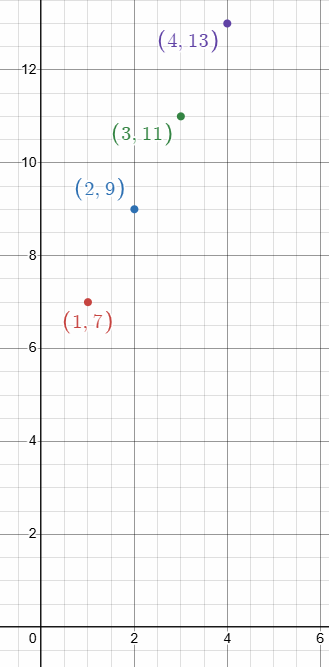
c) fn = 5 + 2n
amount spent for playing games = $29
29 = 5 + 2n
2n = 29 - 5
2n = 24
n = 24/2
n = 12
So, you may play 12 games.
Example 7 :
Write a sequence that represents the number of smiley faces in each group. Is the sequence arithmetic? Explain
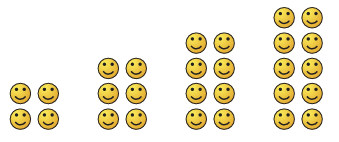
Solution :
Number of smiley faces,
4, 6, 8, 10, ...............
Each term is increased by 2. So, this sequence represents arithmetic.
Example 8 :
The total number of babies born in a country each minute after midnight January 1st can be estimated by the sequence shown in the table.
|
Minutes after midnight January 1st 1 2 3 4 |
Total babies born 5 10 15 20 |
a. Write a function that represents the arithmetic sequence.
b. Graph the function.
c. Estimate how many minutes after midnight January 1st it takes for 100 babies to be born.
Solution :
a)
fn = a + (n - 1) d
a = 5, d = 10 - 5 ==> 5
fn = 5 + (n - 1) 5
= 5 + 5n - 5
fn = 5n
b)
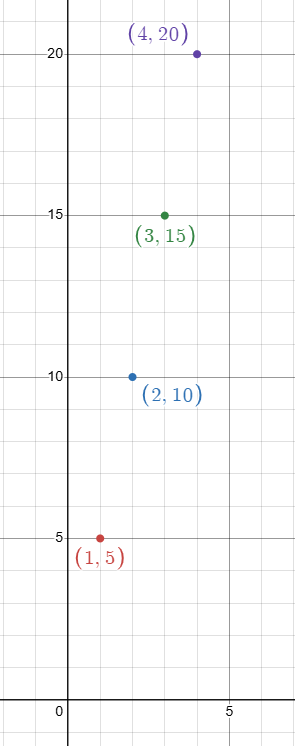
c)
fn = 5n
Here fn = 100
100 = 5n
n = 100/5
n = 20
So, the required number of minutes is 20.
Subscribe to our ▶️ YouTube channel 🔴 for the latest videos, updates, and tips.
Kindly mail your feedback to v4formath@gmail.com
We always appreciate your feedback.
About Us | Contact Us | Privacy Policy
©All rights reserved. onlinemath4all.com

Recent Articles


-
Digital SAT Math Practice Test with Answers (Part - 17)
Sep 29, 26 12:20 PM
 Digital SAT Math Practice Test with Answers (Part - 17)
 -
Digital SAT Math Practice Test with Answers (Part - 16)
Sep 07, 26 11:23 AM
Digital SAT Math Practice Test with Answers (Part - 16) -
Digital SAT Math Practice Test with Answers (Part - 15)
Aug 23, 26 12:24 PM
 Digital SAT Math Practice Test with Answers (Part - 15)

